
Antimicrobial coating trial to fight hospital infections
An antimicrobial coating for hospital surfaces and equipment could prevent healthcare-associated infections such as ‘golden staph,’ which cost Australia’s health system $1 billion every year.
University of Queensland researchers are testing the performance of safe antimicrobial coating NanoAM – an eco-friendly coating made from Queensland agricultural waste.
The trial is underway as part of the Critical Care Research Group’s Intensive Care Unit of the Future at The Prince Charles Hospital, Brisbane, and is funded through The Prince Charles Hospital Foundation.
NanoAM lead developer, Associate Professor Nasim Amiralian of UQ’s Australian Institute for Bioengineering and Nanotechnology, said the coating was designed to improve patient safety and protect hospital staff from microbes in hospital environments, which include bacteria and viruses.
“The technology works by converting green waste, including sugarcane, banana and hemp, into long-lasting, hospital-grade surface protection,” Dr Amiralian said.
“Acting as a sustainable, self-cleansing and non-toxic shield, the coating kills pathogens and prevents microbial build-up – in turn reducing hospital-acquired infections in vulnerable patients and prolonged hospital stays.”
Through the reduction of healthcare-associated infections, the technology could contribute to saving Australia’s healthcare system an estimated $1 billion every year.
“However, success for us is not only making a change to patients’ lives,” Dr Amiralian said.
“We are also focused on protecting healthcare workers, who can easily pick up infectious bacteria during patient care, and finding ways to reduce that risk.”
Healthcare associated infections are a major financial burden on Australia’s healthcare system, with infections responsible for 38 per cent of all hospital-acquired complications and contributing to 7000 deaths each year.
Dr Amiralian said Queensland hospitals currently relied on chlorine or bleach-based disinfectants to address infection risk.
“These existing hospital approaches are short-lived – damaging surfaces, fuelling antimicrobial resistance, releasing toxic materials —while generating tonnes of chemical and hazardous healthcare waste across the state every year,” Dr Amiralian said.
CCRG Director, Professor John Fraser AO said the technology could lead to not only huge opportunities for Australia, but improved patient outcomes globally.
“For some time, we have recognised the devastating impact hospital-acquired infections can have on patients, often leading to increased use of antibiotics, contributing to antimicrobial resistance,” Professor Fraser said.
“The trial aims to reduce antimicrobial contamination in ICU on surfaces, making the hospital environment safer for patients and their caregivers.
“This is just another example of how world-class collaboration across multidisciplinary teams can lead to major improvements in healthcare and save lives.”
Dr Amiralian said if the trial is successful, the technology could be extended to other healthcare settings and applied to public services including food contact surfaces.
The trial is expected to run for 2 years.
Collaborators - Dr Sandya Athukoralalage, Post-Doctoral Research Fellow and Chief Investigator on the NanoAm technology at UQ’s Australian Institute for Bioengineering and Nanotechnology; and Professor John Fraser, Associate Professor Jacky Suen, Dr Oystein Tronstad and Adrian Goldsworthy from The Critical Care Research Group; Dr Andrew Burke, Director, and Janice Geary, Clinical Nurse Consultant of Infectious Disease at The Prince Charles Hospital collaborating investigators on this project.
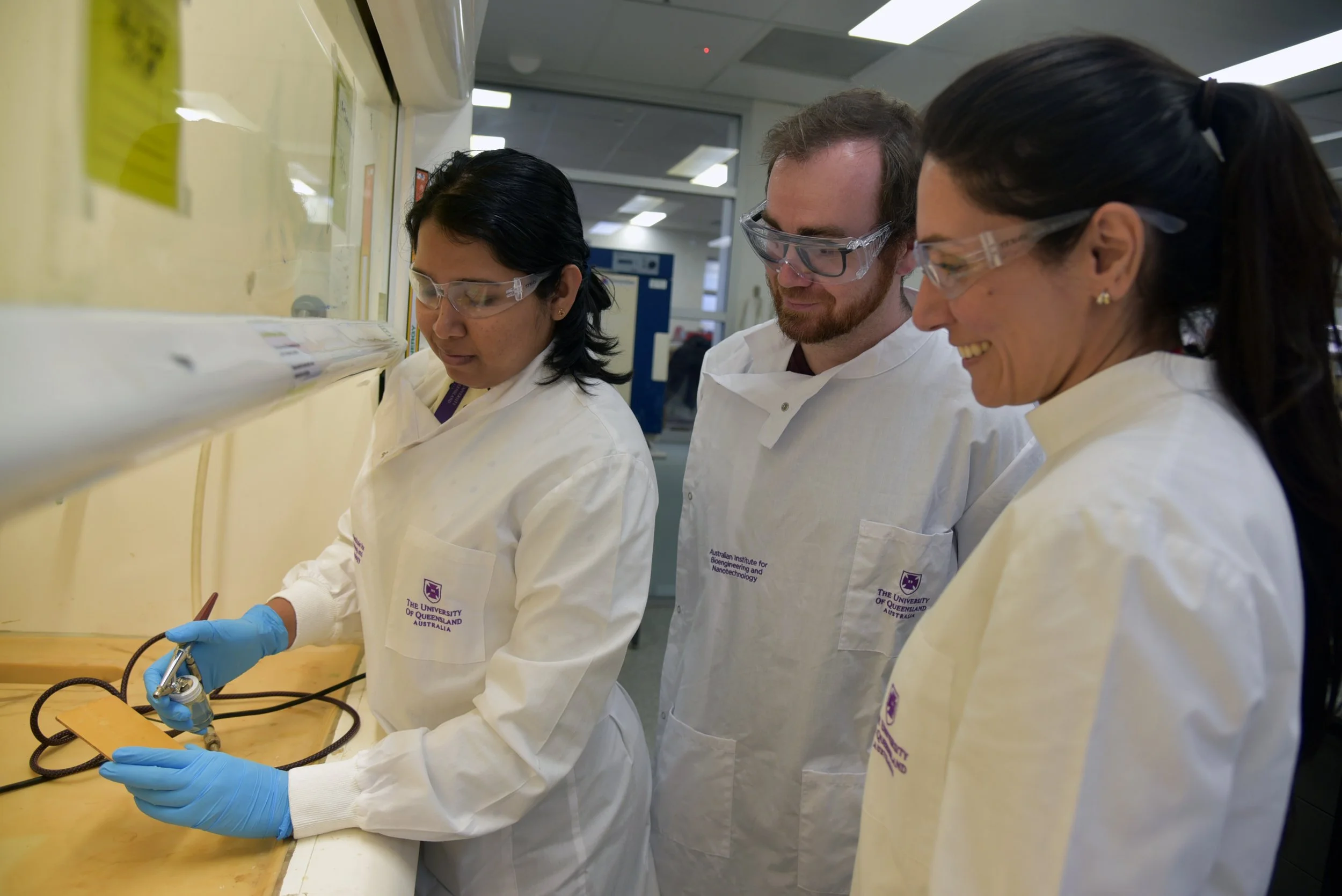
University of Queensland researchers Dr Sandya Athukoralalage and Associate Professor Nasim Amiralian, together with CCRG’s Adrian Goldsworthy (centre) have developed sustainable antimicrobial coating to help prevent healthcare-associated infections. Photo: The University of Queensland.