
Australian-First Study Targets Superbugs Hiding on Mobile Phones in Hospitals
We all love our phones, but when used in hospital wards they have the potential to pick up and spread dangerous superbugs.
A new study by investigators at the Critical Care Research Group (CCRG), together with The University of Queensland Institute for Molecular Bioscience and The Wesley Research Institute, aims to find out just how big a problem this is – and whether exposure to special ultraviolet light (UV-C) can make phones safer for use in hospitals.
Every year more than 200,000 Australians pick up an infection while in hospital. Many of these bugs are tough, antibiotic-resistant types that make people sicker for longer and, sadly, claim thousands of lives. Phones are essential tools for providing hospital staff with all the information they need to provide best patient care and are used constantly by doctors, nurses, patients and visitors. However, they can also act as carriers for pathogens.
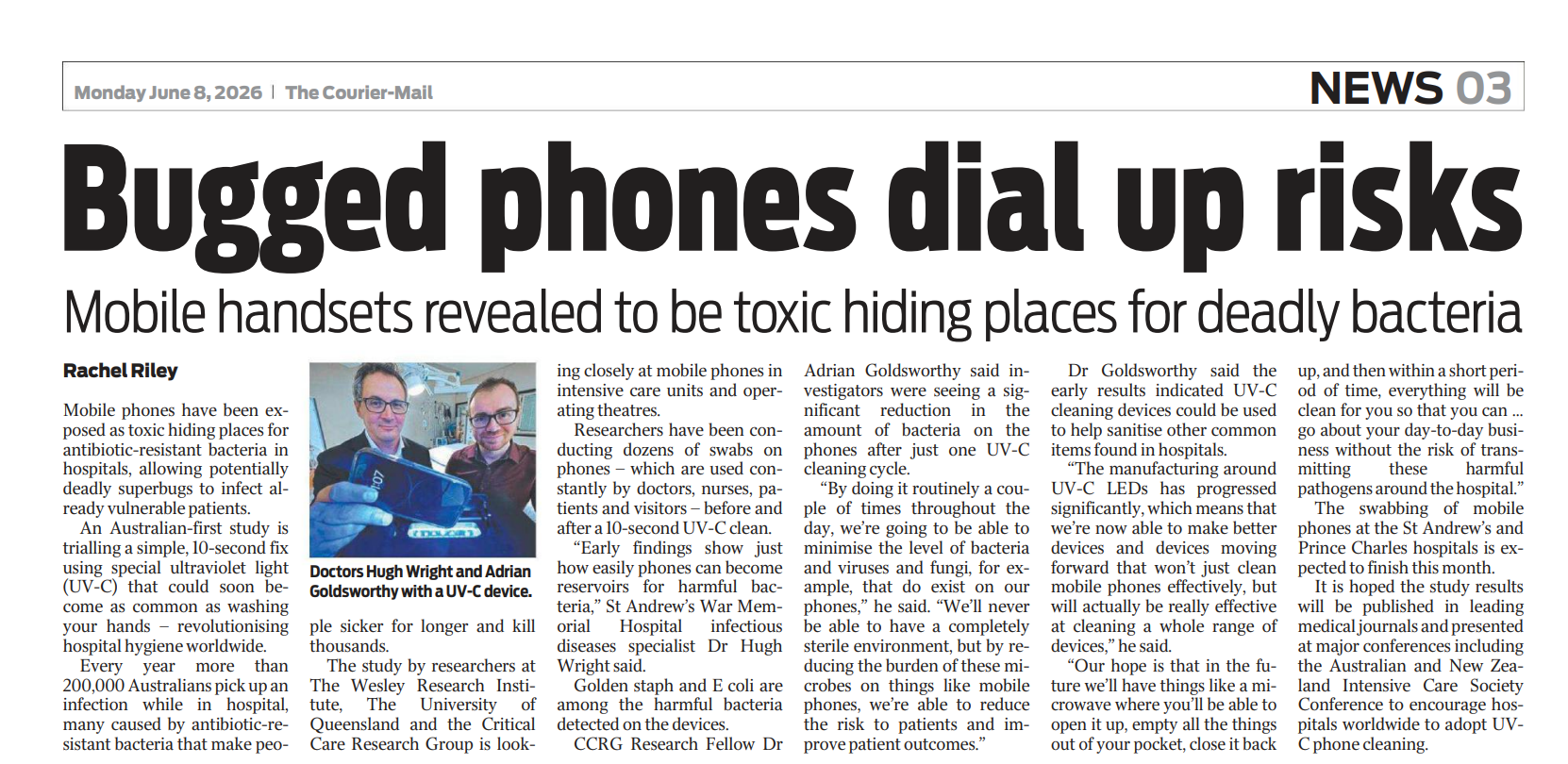
Led by CCRG’s Dr Adrian Goldsworthy, St Andrew’s War Memorial Hospital’s infectious diseases specialist Dr Hugh Wright, and staff at The Prince Charles Hospital, the project team is looking closely at mobile phones in intensive care units and operating theatres, observing how phones are used day-to-day and swabbing phones before and after a quick 10-second UV-C clean.
CCRG Research Fellow Dr Adrian Goldsworthy said the project could “redefine infection control in hospitals worldwide”.
“By combining cutting-edge microbiology with practical solutions, we’re working to protect patients and healthcare workers alike,” said Dr Goldsworthy.
“We’ll never be able to have a completely sterile environment, but by reducing the burden of these microbes on things like mobile phones, we’re able to reduce the risk to patients and improve patient outcomes.”
”Early findings show just how easily phones can become reservoirs for harmful bacteria,” said Dr Wright.
“Mobile phones are essential tools, but we need to treat them the same way we treat our hands. A 10-second UV-C clean could slot straight into existing hand-washing routines and give patients extra protection.”
The study garnered national coverage across News Corp papers this month, below courtesy of The Courier-Mail.
Thumbnail image courtesy Glissner.