
Biomedical Engineer brings her skills in translational research back to ICETLab
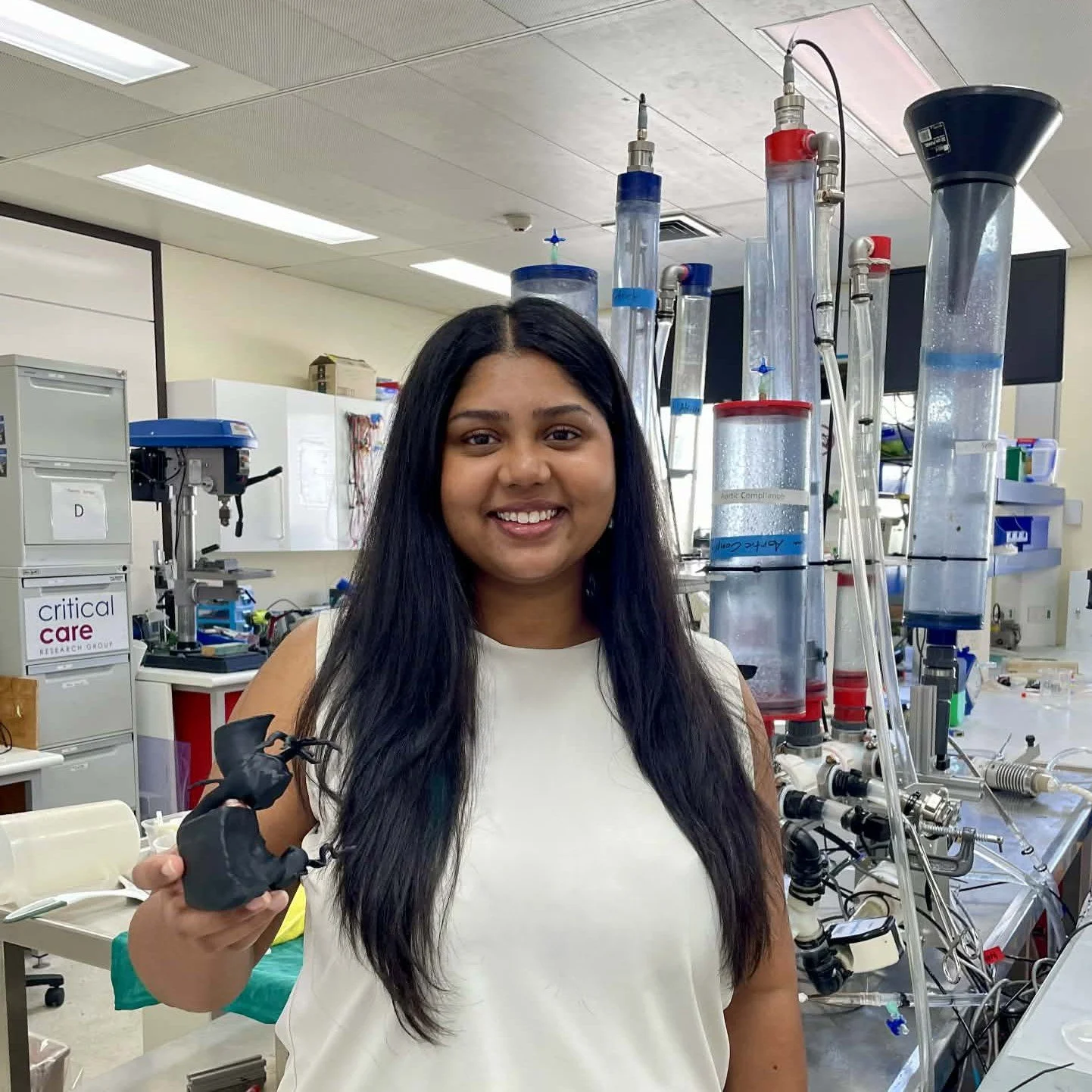
After undertaking an internship with CCRG’s Innovative Cardiovascular Engineering and Technology Laboratory (ICETLab) in 2019, Biomedical Engineer Haveena Anbananthan has returned, bringing her experience in computational fluid dynamics (CFD) to the Group’s ongoing engineering program.
Following in the footsteps of her father, who relocated from Malaysia to Queensland to study, Haveena came to Brisbane to complete her Bachelor in Engineering (Honours) at the Queensland University of Technology.
“While studying medicine was an early consideration for me, I was ultimately drawn to biomedical engineering as it allows me to support technical engineering activities and developments while maintaining a direct connection with improving patient outcomes,” says Haveena.
Haveena was introduced to CCRG when she attended a talk by ICETLab alumnus Jo Philipp Pauls, who spoke about the Group’s blood trauma modelling and heart pump research. She then completed a year as an undergraduate researcher with CCRG, before returning years later to lend her expertise in cardiovascular systems engineering and CFD simulations.
“My PhD focused on understanding the disease progression of brain aneurysms using CFD, and while this work is somewhat removed from what we’re currently doing at CCRG, I can essentially apply my research skills from the brain to the heart and lungs. The fundamentals are highly similar - there is still blood flow and a pulse.”
In the ICETLab, Haveena is currently working on the pulsatile ECMO research program, incorporating CFD simulations with CCRG’s internationally renowned mock circulatory loop to investigate novel ECMO configurations.
“We are examining the effects of different ECMO configurations on blood flow as it is returned and circulated through the body. Validation tests are then carried out to confirm if the simulations we see preclinically align with what is seen in clinical settings.”
A key advantage of the ICETLab is its close collaboration with clinicians, enabled by its location within the walls to The Prince Charles Hospital. This allows the team to support the 3D printing of patient-specific anatomical models from medical imaging for educational purposes, particularly for unique or complex cases.
“These life-size models are created with specialised 3D printers, allowing us to properly observe and understand different disease states and interventions,” explains Haveena.
“I truly believe that the team at CCRG and our cutting-edge technology and engineering expertise have the capability to expand on our cardiovascular research to the pulmonary system and support the development of the first model of a portable lung. It’s a very real possibility and something I would be so honoured to work on and see come to fruition.”
When not working in the lab on 3D models, Haveena plays an array of sports including football, netball, golf and her favourite badminton - hoping to skillfully master them all.