
CCRG researchers named as recipients of The Prince Charles Hospital Foundation’s PhD Scholarships
Congratulations to CCRG’s Dr Quentin Moyon and Michael Garbutt, two of the six recipients of the 2025 PhD Scholarships awarded by The Prince Charles Hospital Foundation.
The scholarships support passionate researchers dedicated to improving patient outcomes, including Quentin and Michael’s work here at CCRG.
“I am extremely grateful for the support. This scholarship allows me to fully dedicate myself to the research and to join an outstanding team at CCRG. None of this work would be possible without the generosity of The Common Good and its donor community, and I truly appreciate their commitment to advancing critical care research,” said Quentin.
“This scholarship allows me to fully dedicate myself to advancing ECMO technology and contributing to meaningful innovation within critical care medicine. I am deeply grateful for the belief that The Common Good and their donors have shown in my work and their commitment to improving patient outcomes through research,” said Michael.
Meet the researchers below.
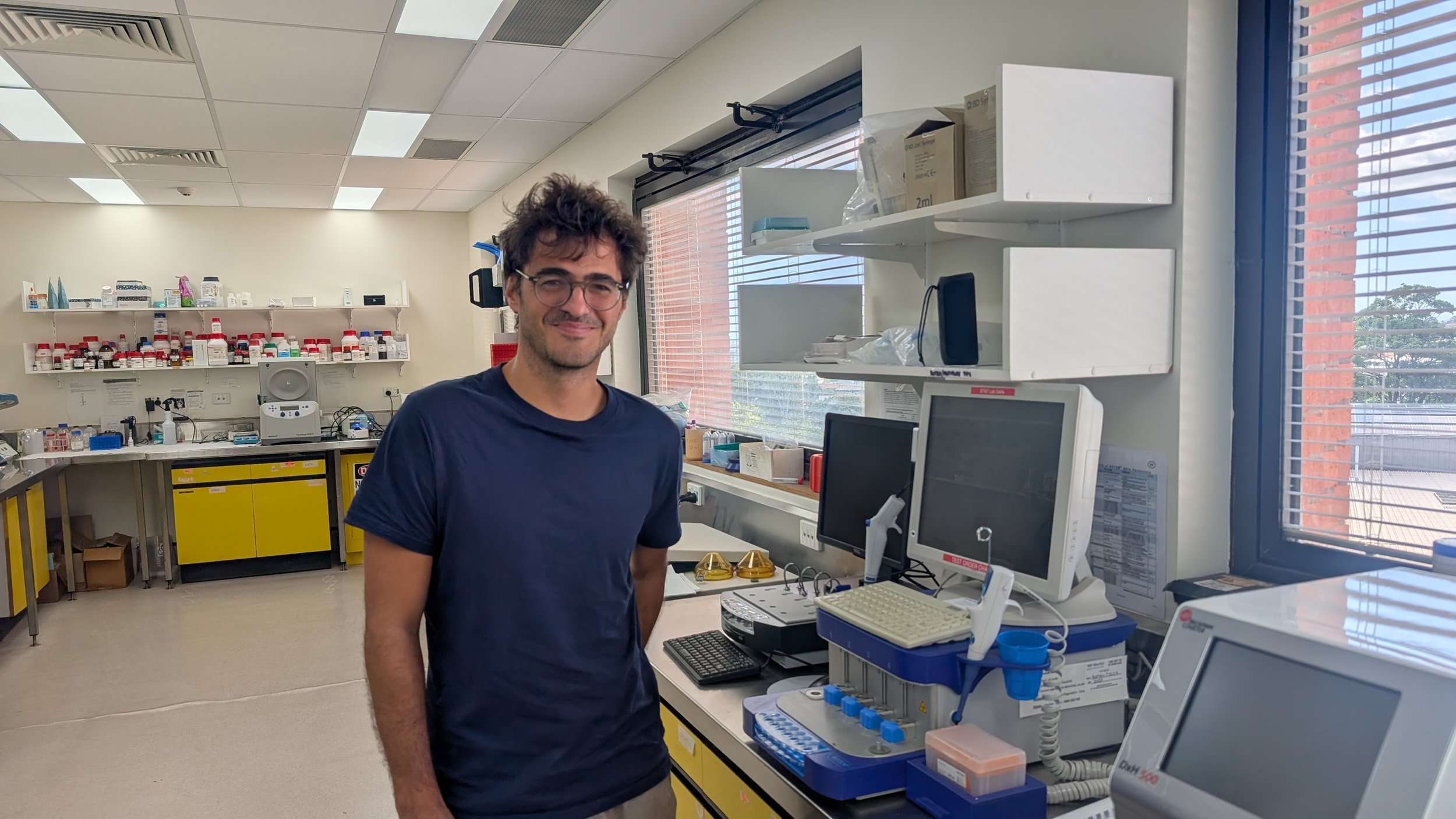
International Research Fellow, Dr Quentin Moyon joined CCRG from France.
Dr Quentin Moyon, International Fellow
Title of project:
An investigation on the benefits of pulsatile V-A ECMO in an preclinical model of cardiogenic shock
What is your research focusing on for your Doctor of Philosophy?
My PhD focuses on improving the way we support patients with severe heart failure using Extracorporeal Membrane Oxygenator (ECMO). ECMO is an advanced life-support technique that temporarily takes over the work of the heart or lungs by circulating and oxygenating the blood outside the body. At the moment, ECMO provides a continuous blood flow, which can increase the workload of the heart and contribute to complications. My research aims to develop and optimise a pulsatile ECMO system that better mimics the natural heartbeat and offers improved protection for the heart and other organs. The project combines in-vitro models, advanced monitoring and translational work in large-animal studies.
Why is this area of research important?
Despite major progress, outcomes for patients on ECMO remain limited. The heart often struggles against the continuous flow of the pump, which can worsen its condition. By understanding how pulsatile flow interacts with the heart and circulation, we hope to develop strategies that reduce complications and improve patient recovery. This could benefit a wide range of critically ill patients in the future.

Michael Garbutt will undertake his PhD with CCRG’s ICETLab
Mr Michael Garbutt, PhD Candidate in CCRG’s ICETLab.
Title of project:
Computational and Experimental Design of Extracorporeal Membrane Oxygenator (ECMO) Housing to Minimise Haemolysis and Thrombogenic Risk
What is your research focusing on for your Doctor of Philosophy?
Despite providing lifesaving treatment to critically ill patients, current ECMO systems are limited by some significant complications, such as haemolysis (red blood cell damage) and thrombosis (formation of blood clots). These issues can result in reduced effectiveness of the treatment and serious clinical consequences for the patient. My research will focus on redesigning current ECMO housing geometries with a haemodynamic-focused approach to minimise the incidence of haemolysis and thrombosis. Through a combination of fluid dynamics simulations, physical prototyping and consultation with the wider research group, my goal is to create a safer, more efficient ECMO device that reduces the incidence of haemolysis and thrombosis, ultimately improving patient outcomes.
Why is this area of research important?
Haemolysis and thrombosis result in a range of adverse outcomes for ECMO patients. These complications can result in prolonged hospital stays, increased healthcare costs and, most importantly, reduce the chances of survival. Improving ECMO technology has the potential to directly save lives and enhance the quality of care for patients in critical care. By addressing the underlying mechanical design and optimising to reduce haemolysis and thrombosis, this research aims to make ECMO safer, more accessible and more effective for patients who rely upon it during life-threatening illness.