
PhD Candidate from The Netherlands celebrates one year at CCRG
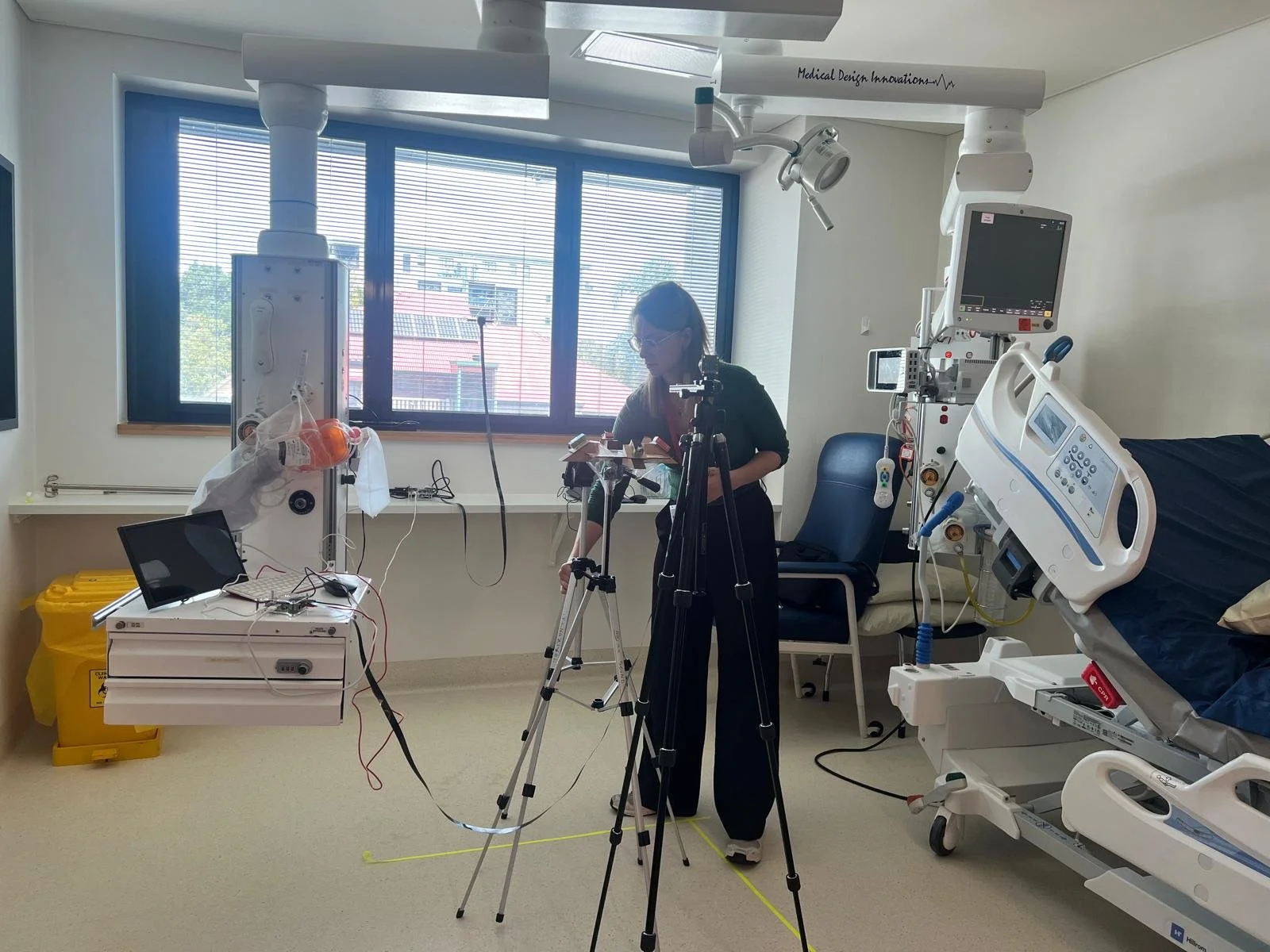
Iza conducting lighting measurements as part of the ICU of the Future project.
For PhD Candidate Iza Linders, it was a special interest and expertise in human-centric lighting that led her to join CCRG last year. One year on, she reflects on joining the group and her experience investigating the innovative lighting systems, including circadian-focused lighting, within CCRG’s world-first ICU of the Future.
“I moved from The Netherlands to Australia to commence my PhD research, examining the impact of light on sleep quality in critically ill patients in intensive care,” she reflects.
“Light is incredibly powerful yet often overlooked, particularly its effect on human health and wellbeing. Despite being essential to our health, we spend most of our time indoors under artificial lighting, missing out on the benefits of natural light that our bodies have evolved to depend on.”
Before joining CCRG, Iza completed her Bachelor of Science - Psychology and Technology (Innovation Sciences) and Master of Science - Human-Technology Interaction at Eindhoven University of Technology (TU/e) in The Netherlands. There, she was also involved in major projects including Blue Jay Eindhoven and GLOW Eindhoven Light Art Show.
“During my Masters, I undertook an exchange program with the Technical University of Berlin where I studied Industrial Engineering and Sustainability Management, learning more about design thinking, sustainable development, project management, and energy and climate change.
“My Masters thesis then focused on movements of dappled light patterns and their influence on stress recovery. From here I was introduced to Dr Francisca Rodriguez (Lecturer, Interior Design) and A/Prof Veronica Garcia-Hansen, and was excited to explore potential research collaborations with them; this ultimately led to a PhD with QUT. with the CCRG as a collaborating research group.
At CCRG, Iza is working closely with Dr Oystein Tronstad investigating the lights used in the ICU of the Future bed spaces at The Prince Charles Hospital.
“In ICUs, the circadian rhythm, or the patient’s biological clock, can be disrupted due to the unnatural timing, intensity, duration, and spectrum of the electrical lighting and the lack of natural light, negatively impacting patient outcomes. Our research investigates how intelligent lighting can support improved patient outcomes and help establish an evidence base for future ICU lighting standards and design guidelines,” explains Iza.
One of CCRG’s core strengths is its depth of multidisciplinary collaborations, bringing together clinicians with lighting engineers and designers to enable more consistent and meaningful research outcomes in this field.
“I’m used to working in a controlled research lab, but an ICU is a dynamic and complex environment with many competing factors. It has also been a whole new experience of working in a clinical setting. So it’s been a great challenge and opportunity to take on both the new learning experiences and the new environment!”
“I am excited to bring a distinct approach to the ICU of the Future project with my specialised expertise in lighting. By combining my investigative knowledge with the team’s clinical experience, our collaborative skillset will be the most effective in achieving improved outcomes for ICU patients.”
Away from the ICU and university, Iza loves camping and everything to do with the outdoors.
“Working so closely with light and its impact on human health has made me even more aware of how important natural light is in my own life. That’s why I prioritise getting outside and soaking in the natural rhythm of the sun.